
What Is a Hydraulic Press Brake? Applications, Advantages, and the Dener Difference

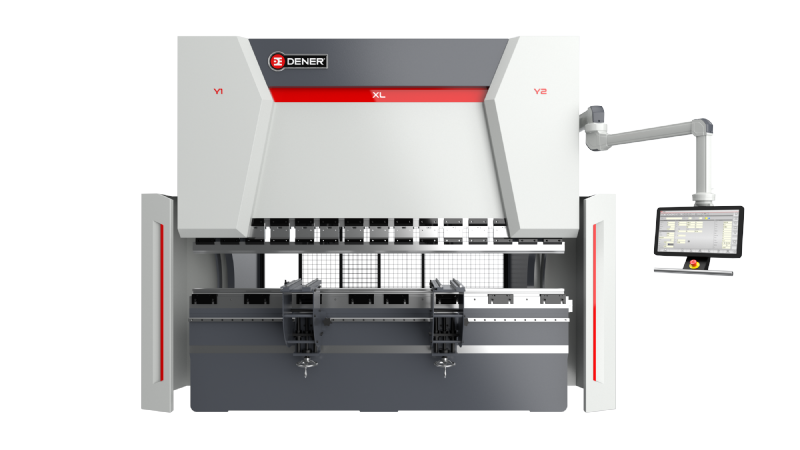
A hydraulic press brake is an industrial sheet metal processing machine that bends metal sheets into the desired angles and shapes. It delivers stable performance, particularly in applications requiring high tonnage and when bending thick sheets and long workpieces.
What Is a Press Brake?
A press brake is a machine that bends sheet metal by applying controlled force between upper and lower tooling. In hydraulic models, this force is generated by hydraulic cylinders, while the CNC control unit precisely manages the angle, stroke, and backgauge positions.
How Does a Hydraulic Press Brake Work?
In hydraulic press brakes, bending force is generated by cylinders powered by hydraulic oil pressure. The CNC control system manages the bending angle, stroke distance, backgauge axes, and bending sequence, making operation easier and supporting process standardization.
Programmable bending steps enable quick setup and save time in repetitive production.
Correct tooling selection and CNC parameters help achieve more consistent angles and dimensions.
Which Industries Use It?
- Sheet metal fabrication workshops and subcontract manufacturing
- Machinery manufacturing and chassis production
- Automotive and automotive suppliers
- White goods and household appliance components
- Electrical panel and enclosure manufacturing
- Elevator cabin/door manufacturing
- Steel construction and heavy industry
Why Choose a Hydraulic Press Brake?
- Powerful and balanced bending in applications requiring high tonnage
- Stable performance and a lower risk of deviations when bending thick sheets
- Long service life and production continuity with a robust frame
- Repeatable quality and lower scrap rates with CNC control
Production Tolerances and Bending Precision
Press brake precision is directly related to material type, sheet thickness, tooling geometry, CNC settings, and machine rigidity. With the right configuration, bending angle repeatability improves, parts fit together better, and quality standards are easier to maintain.
Service and Spare Parts Approach
When selecting a hydraulic press brake, factors beyond the initial investment cost also matter, including the service network, spare parts availability, ease of scheduled maintenance, and technical support processes. These factors add value by helping maintain production schedules and long-term efficiency.
- Prompt service scheduling and periodic maintenance support production continuity
- The use of standard components simplifies spare parts access and procurement
- Scheduled maintenance helps extend hydraulic system service life and maintain consistent performance
What Sets This Model Apart?
Dener hydraulic press brakes are designed to deliver stable bending even under high tonnage, quick setup, and operational continuity. Their rigid frame design, CNC control system, and production-focused ergonomics meet the needs of various industries.
Frequently Asked Questions
What is the difference between a hydraulic press brake and a servo/electric press brake?
Hydraulic press brakes deliver powerful performance in high-tonnage and thick-sheet applications. Servo/electric models may offer energy efficiency and speed advantages in certain scenarios. The right choice depends on the type of part and production requirements.
What are the most important criteria when choosing a press brake?
Sheet thickness, bending length, required tonnage, CNC capabilities, backgauge axes, tooling compatibility, and service and spare parts support are key factors in the selection process.
What should I consider for precise bending?
Appropriate tooling selection, material variability (tensile strength), correct CNC parameters, and regular maintenance are essential for maintaining precision.
Contact us via WhatsApp to find the most suitable solution based on your part dimensions, sheet thickness, and production goals.
Contact Us